


FREQUENTLY ASKED QUESTIONS
Clear answers.
THE DEVICE
Getting to know LUCIDA VR.
Who is LUCIDA VR designed for?
LUCIDA VR is designed for older adults with diagnosed cognitive decline, particularly mild cognitive impairment and early forms of neurocognitive deterioration. The professional assesses the device’s suitability, the therapeutic goals and the level of assistance needed.
Does LUCIDA VR cure or prevent Alzheimer’s disease?
The therapeutic purpose of LUCIDA VR is to address cognitive decline by stimulating different cognitive functions, as part of a supervised clinical pathway.
This purpose does not amount to a promise of a cure, of halting disease progression or of preventing Alzheimer’s disease. The device’s specific clinical effects must be assessed through dedicated studies.
Who chooses the exercises?
The healthcare professional defines the goals, authorised activities and initial levels.
The AI assistant envisaged by the protocol will be able to select subsequent tasks only within the established clinical plan.

THE SESSION
Inside the experience.
How long does a session last?
The protocol envisages approximately 30 minutes:
5 initial minutes of welcome and relaxation;
22 minutes of cognitive stimulation;
3 closing minutes.
Individual circumstances and any need for adjustments must be assessed by the professional.
Do I need to stand or move around the room?
No. The experience is designed to take place while seated.
Do I need to use controllers?
The main planned interaction method uses the hands to point to, touch and move virtual objects.
This method will need to be tested in the final application.
Do I need to be experienced with technology?
No. The device is designed to be usable by people who are unfamiliar with digital tools as well.
Its actual ease of use will be assessed through dedicated testing.
Is a virtual assistant I can talk to planned?
Yes. The integrated protocol envisages a conversational AI assistant that can explain exercises, answer questions and offer progressive assistance.
Activity selection within the clinical plan and the preparation of summaries for the professional are also planned.
These are planned functions whose operational availability remains to be confirmed.

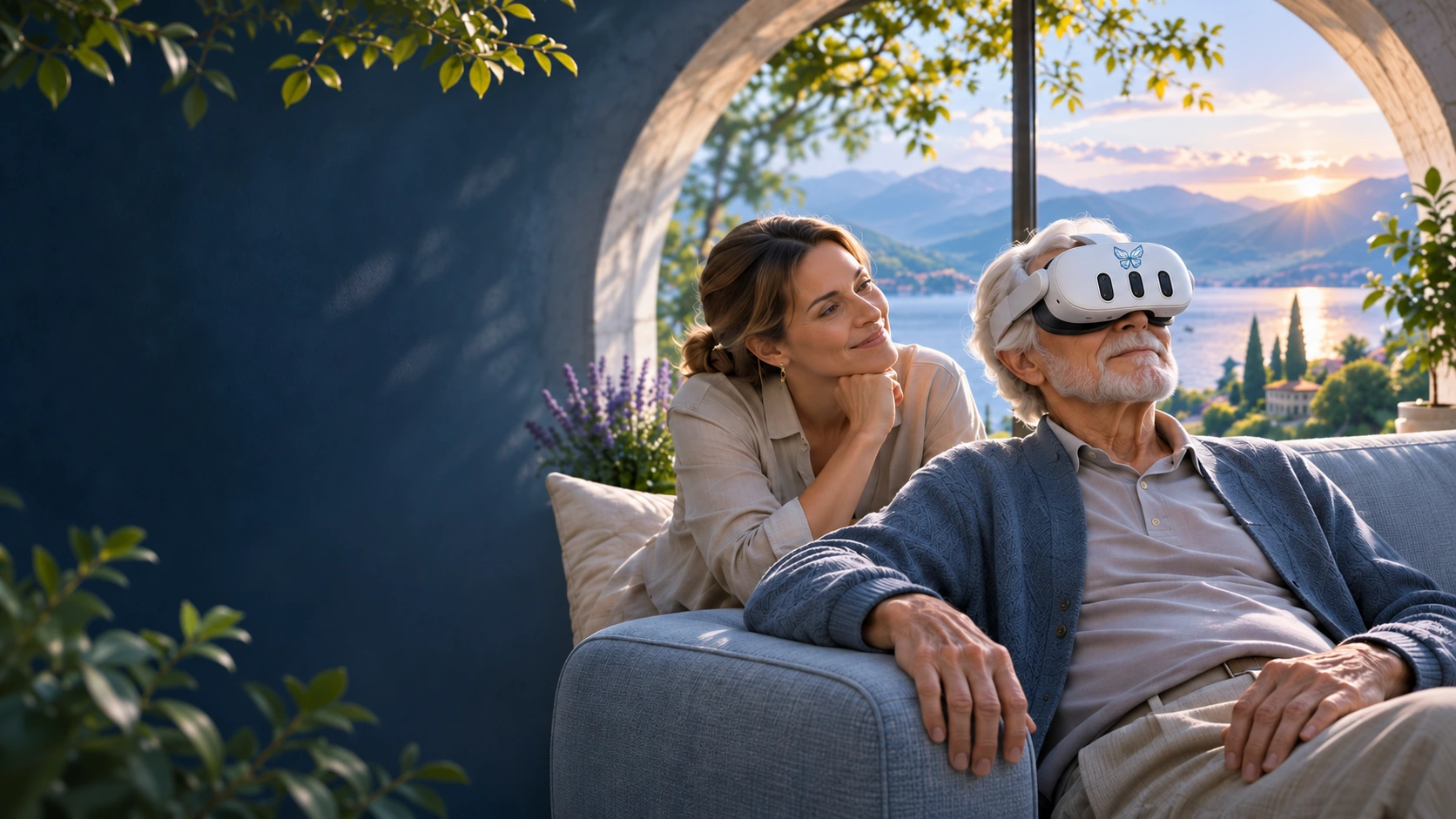
Illustrative preview of the experience in the headset.
AT HOME AND IN CARE FACILITIES
A supervised care pathway.
Can LUCIDA VR be used at home?
The device is also designed for home use within a care pathway supervised by a professional.
The person’s suitability and the practical arrangements will need to be assessed before use.
Does a family member need to be present?
A caregiver’s presence may be helpful, especially at the beginning or when the person needs assistance.
The degree of independence will need to be assessed individually.
THE PROJECT
Research and availability.
How will the professional follow activities remotely?
The portal is designed to collect information on completed exercises, results and difficulties.
Automatic notifications are planned when situations defined by clinical rules occur.
Do exercise scores indicate clinical improvement?
Not necessarily.
Digital performance measures describe what happens during the exercises. Assessing clinical improvement requires the professional’s interpretation and appropriate tools.
Does LUCIDA VR replace the doctor?
No.
The system is not designed to replace the healthcare professional, make diagnoses or independently decide on treatment.
The first step is to talk.
Discover LUCIDA VR and the pathway best suited to your needs.